Survey and Spatial New Zealand
AI Beyond the Field: practical wins for surveying workflows
Presenting for Patersons to 80 surveyors and spatial professionals in Auckland. Not drones or LiDAR: the office work that eats non-billable hours, and what AI is already doing about it inside a New Zealand firm.
- Date
- Event
- Survey and Spatial New Zealand
- Where
- Auckland
- Audience
- 80 in the room
- Role
- Presenting for Patersons
The real problem is back in the office
I work three days a week at Patersons as their fractional AI engineer, building internal AI tools and automations. Not replacing anyone, augmenting what the team already does.
Most of the AI hype in surveying is about drones and LiDAR. But the biggest time sink isn't in the field, it's back in the office: hours rewriting field notes into client invoices, manually checking five or more map viewers for every site, and writing repetitive scripts for point cloud processing. AI doesn't need to replace professional judgement. It needs to free up more time for it.
Three examples from Patersons
Invoice line items. Field shorthand is confusing for clients and every staff member writes descriptions differently. An n8n automation now rewrites raw field notes into clear, consistent, client-facing line items. Staff review and approve instead of rewriting, and a batch that took 30+ minutes takes seconds, with a human still in the loop.
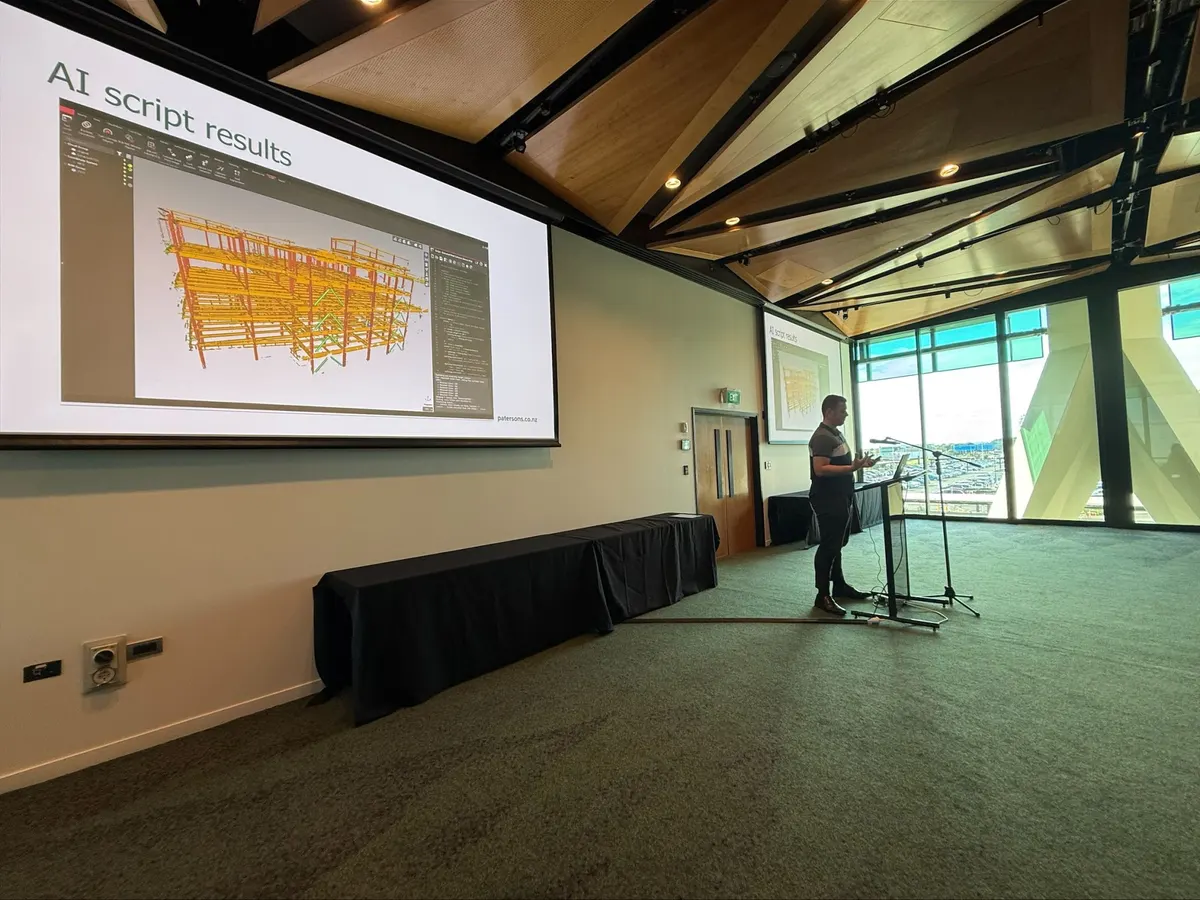
Point cloud scripts. A surveyor describes in plain language what they need extracted from the point cloud, AI writes the Cyclone 3D script with the syntax and parameters handled, and the surveyor reviews it and runs it. No programming needed.
Site intelligence. One address in, full site context out: the address is geocoded, the ArcGIS map layers are queried, and a site report comes back with zoning, water supply, stormwater, sewer layout, district plan overlays and services.
- A Copilot Studio agent that reviews Resource Consent Application documents for completeness.
- "Ask Pat", an internal HR coaching agent for managers.
- A ProjectWorks API integration for AI-powered project reporting.
- n8n automations for data sync and document routing.
What it means for the industry
Smaller firms can punch above their weight: less overhead on non-billable admin means a lean team can match a large one on responsiveness. Junior staff develop faster, spending less time on data entry and more on core surveying skills. And the barrier is lower than people think. You don't need a data science team; no-code tools like n8n and Copilot Studio are within reach of any size of firm.
How to get started
What I suggested the room take back to their firms:
- Start with the pain. Ask the team which tasks they dread and what is eating their non-billable hours.
- Augment, don't replace. Layer AI into the software and processes your team already knows.
- Keep humans in the loop. AI drafts, people review. It builds trust, catches errors and keeps professional accountability where it belongs.
- Start small and iterate. One workflow, one automation, prove the value, then expand.
Survey and Spatial New Zealand
This is the talk as I gave it, written up from my slides and notes. More talks are in the speaking log. Speaking enquiries go through Harkness AI.