NZ IT & AI Job Forum
Graduating into a World of AI: from student to founder in 18 months
My talk at the NZ IT & AI Job Forum at the University of Auckland: the actual order I did things in after graduating, the four skills employers are hiring for, and how to get around a pile of AI-written CVs.
- Date
- Event
- NZ IT & AI Job Forum
- Organiser
- Auckland Chinese Families Network
- Where
- Owen G Glenn Building, University of Auckland, Auckland
- Audience
- 35 in the room
"Go do AI"
Halfway through mechatronics at Massey, ChatGPT launched and could do 100% of my exams, assignments and coding. My first thought was that my degree was worthless. The realisation came later: the degree taught me how to think, and AI was a new tool to apply that to.
My first job was as a graduate engineer in a 140-person company, and the brief was two words: go do AI. Nobody in the building knew what that meant. There was no AI degree, no playbook and no senior to copy. So here is what I actually did, in order.
- I messaged everyone in New Zealand with "AI" in their LinkedIn title and asked for a coffee. Most ignored me. The ones who said yes showed me where the gap was: someone technical enough to build who could also communicate.
- I treated YouTube as the course, and always asked how to use it on the thing in front of me. Applied AI is on you.
- I built side projects that were useful rather than impressive. Glow For Less scans a product's ingredient list and finds cheaper alternatives. Not perfect, but real and shipped, and it is what got noticed.
- I posted what I was learning as I learned it. Six months of that brought seven job offers, the best at double my salary, from zero applications. I turned them all down to build my own thing.
Nobody is an AI expert yet
Generative AI is about four years old, so someone with 20 years in the industry has at most four years with it. New Zealand tech is short around 15,000 people. Normally you grind three to five years inside a company before you're valuable. This flips it.
My example was Terry, a senior engineer who writes his reports by hand: an hour each, charged at $200 an hour, across ten engineers. Teach him to prompt and each report drops to about five minutes, roughly $93,000 a year from one afternoon. Connect Claude or Copilot to the data and the template and it drafts the whole thing; Terry just reviews. Every rung of that ladder is somebody's job to build, and none of it needs a CS degree.
The four skills employers are hiring for
In a deliberate order, with the softest skill first. You don't need all four: one makes you stand out, two or three puts you in a different league.
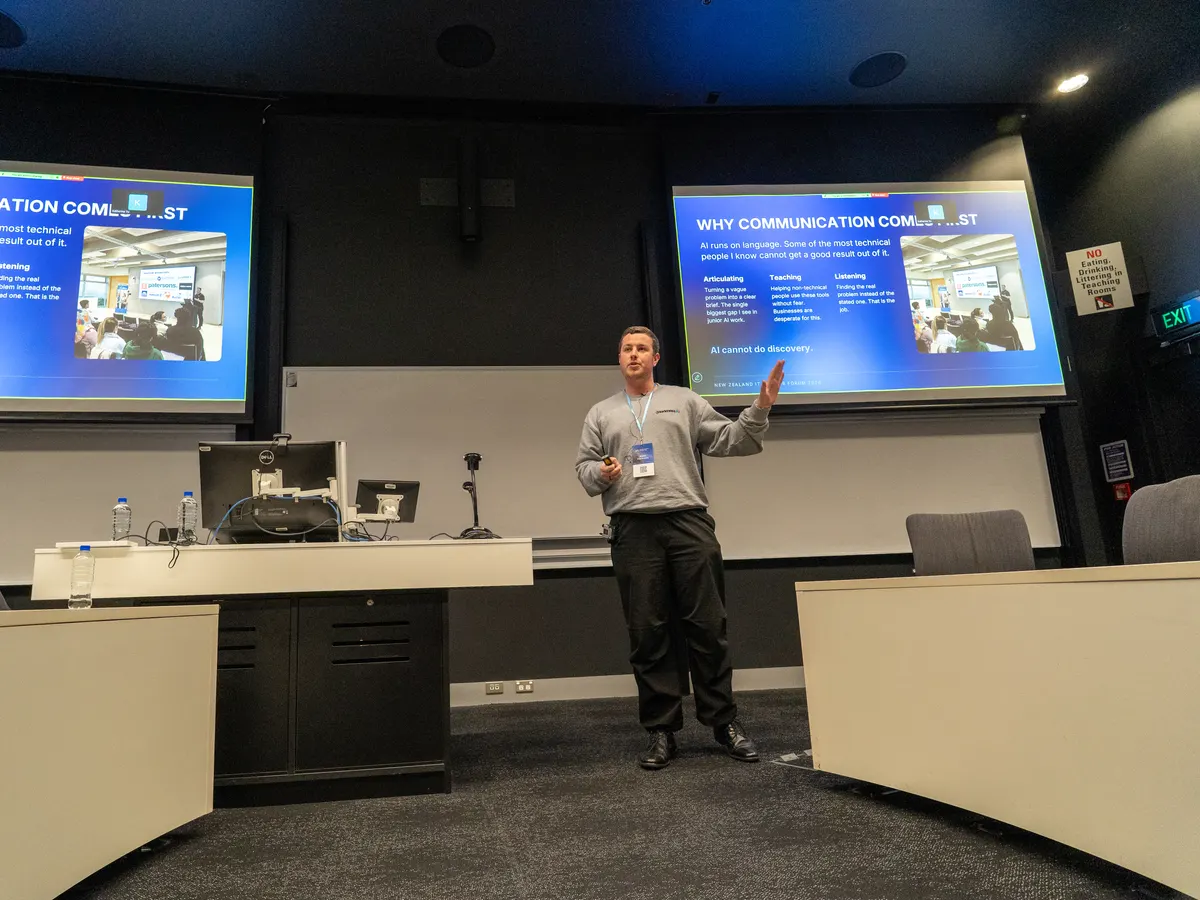
- Communication: turning a vague problem into a clear brief, teaching nervous people, and listening for the real problem. AI can't do discovery.
- Problem solving: finding the real problem instead of the stated one, and knowing which part is worth automating.
- Automation: n8n, Make, Zapier and AI APIs. Almost no grad has it; almost every business needs it.
- Generative AI: prompting, projects, agents and skills. Driving the tools, not just typing into them.
Go around the application
I've never made a hiring decision off a CV. A role that used to pull 20 applicants now pulls 100, almost all of them AI-written and screened by AI. For my own marketing hire I added one step, send me a video on why you want the role, and applications went from about 50 to nine, in a different league for quality.
So find a real problem, build the smallest version, and tell people. Build something for the company before the interview, show the working thing rather than a deck, and talk about what broke. And the degree matters less than you think. We asked a Distinguished Professor at one of China's top universities what young people should study, and the answer was that it doesn't matter, as long as you use AI alongside it.
This is the talk as I gave it, written up from my slides and notes. More talks are in the speaking log. Speaking enquiries go through Harkness AI.