IFAA Conference 2026
From AI to Action: Practical Tools for Advisers
My session opening the final morning of the Independent Financial Advisers Association conference at Rydges Latimer in Christchurch. The brief was to get advisers from knowing what AI could do to using it on Monday, so it was built around demos on a fictional client household, and where the adviser still signs off.
- Date
- Event
- IFAA Conference 2026
- Organiser
- Independent Financial Advisers Association
- Where
- Rydges Latimer Christchurch, Christchurch
Feedback
Blake presented at our IFAA conference and received excellent feedback from our advisers. He made AI easy to understand, with practical examples and useful ideas they could apply in their businesses. His session was a conference highlight and left members keen to learn more. We'd happily recommend Blake to other organisations looking for an engaging speaker on AI.
Not a search tool any more
It was the morning after the conference dinner, so I opened by admitting it might be a tough room. Then I told them why they had seen me in the corner on my laptop: my slides had gone out of date because of an update about an hour earlier. That is how fast this is moving. It is hard for me to keep up too.
The takeaway I gave them up front: AI isn't a search tool any more. Most New Zealanders have now used an AI tool, but for plenty of people the furthest they have gone is asking it to find running shoes. It has moved well past that. It's the newest member of your team, and the session was about how you onboard it.
Nobody in this room is behind
Many of the people in that room have 20 to 40 years in advice. Anyone's experience with mainstream generative AI is about four. Everyone is new to this. Their decades of judgement are not.
The national picture: 84% of NZ knowledge workers already use generative AI, and it could add $76 billion to the New Zealand economy by 2038 (Accenture and Microsoft, 2024). Yet 68% of NZ small businesses have no plans to adopt it (Spark and NZIER SME survey, 2024). Meanwhile, the length of task a model can finish on its own has gone from a three-minute job in 2023 to more than a working day, on METR's task-completion time horizon.
It predicts the next word. It read the internet, but it has never read your client files, your file notes or how you do a review. So it can be confidently wrong. My example: asked whether NZ insurers need a fair conduct programme yet, it searched, found a 2023 article, and said not yet because CoFI doesn't start until 2025. CoFI has been in force since 31 March 2025. Confident, and a year and a half out of date. The fix is a better brief: a vague ask throws a wide, weak beam, and a proper one narrows it onto what you actually wanted.
Where client data goes
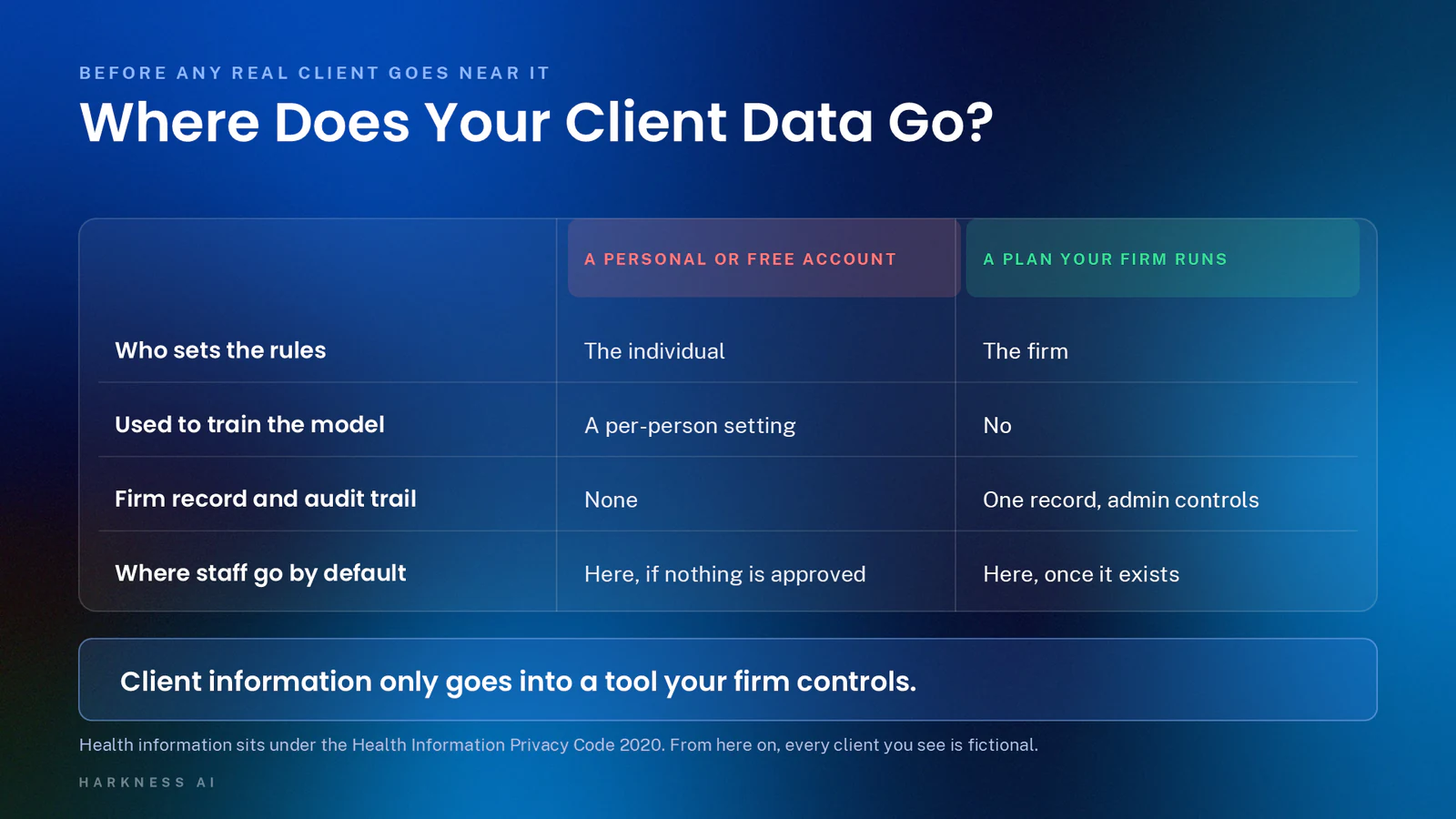
Before any real client goes near it: on a personal or free account the individual sets the rules, training is a per-person setting, and there is no firm record. On a plan the firm runs, the firm sets the rules, it isn't used to train the model, and there is one record with admin controls. Client information only goes into a tool your firm controls, and health information also sits under the Health Information Privacy Code 2020. From that slide on, every client on screen was fictional.
Then the responsible-use list for a licensed business: bias, hallucinations, accountability, transparency, dependency and client data. The line I landed on was that AI changes what you can draft. It does not change who signs.
Data came up from the floor too. My answer was the same as on the slide: free plans are where your information goes everywhere, a business plan is where training is off, and if you are a business you should be on the business plan. I also said plainly that I don't know the inside and out of their compliance obligations, so that part is theirs to check.
From a page of notes to a file note
AI is multimodal: it reads emails and 20-page policy wordings, sees a photo of your handwriting, listens to a meeting recording, and clicks through anything in the browser. The first demo was a photo of handwritten first-meeting notes. "Summarise this" came back with a decent summary, but not a usable one. Then the proper brief: this is a photo of my handwritten notes, turn it into a file note with these headings, and write NEEDS CONFIRMATION wherever you are unsure. That version I could paste straight into a system, with every guess flagged instead of filled in.
Then meetings. Lots of advisers already record meetings with Marloo, Fireflies or their phone, which means you can actually engage with the client instead of writing everything down. The part almost nobody uses is asking the transcript questions afterwards and making it fill your templates rather than its own. I uploaded a transcript with my file note template, and it filled the template and highlighted what I had to check. One meeting gave three hand-offs: a file note the adviser checks, a client email the adviser approves, and a task list the support team picks up.
I use the same pattern for proposals. The meeting transcript, the email chain and the related documents go in together, and the proposals come out more accurate than I could write them, because I can't remember line by line what a client said across five meetings back to back.
A chatbot answers. An agent acts.
Everything up to that point you could have done two years ago. A chatbot takes some information and gives you an output, and you go and do the work. An agent takes a task, connects to your email or your systems, takes multiple steps and does the work, and you check and approve. Mine is connected to my email, calendar and files, and to Xero, where it invoices clients and logs and codes bills. It's the end of copying and pasting between AI and every other window.
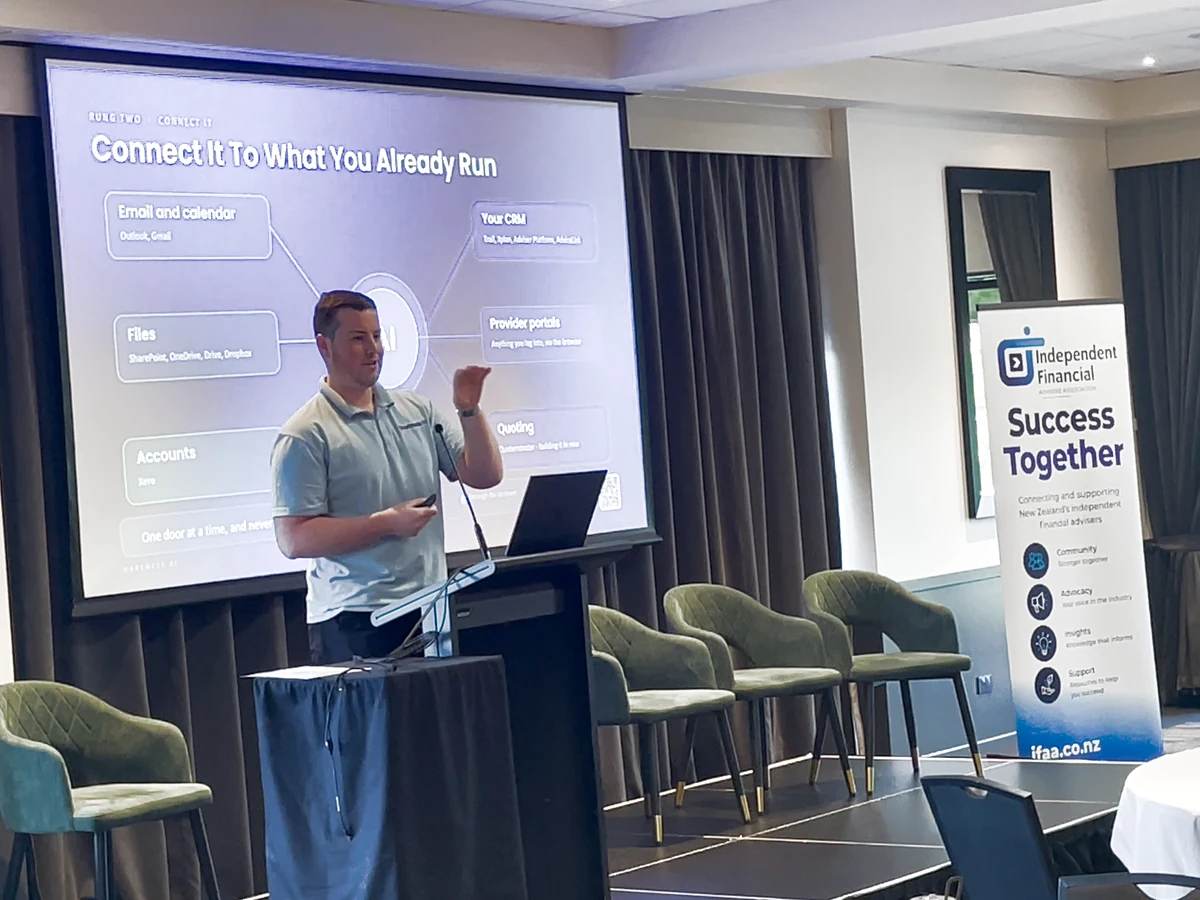
For an advice firm that means connecting it to what you already run: Outlook or Gmail, SharePoint, OneDrive, Drive or Dropbox, Xero, your CRM, and anything you log into through the browser. One door at a time, and never the bank account. The management model: AI is the intern, you are the senior. It reads 40 pages of GP notes in seconds and never gets bored of the tenth file note, but it has no idea how your firm does things and can be confidently wrong. Like a new grad, it needs to be told how the business works, and the review on top still matters.
A Skill is your firm's playbook
Nobody wants to write a paragraph of instructions every time they need a short email. A Skill is a set of instructions the AI follows for a specific task, written once and used by everyone: the adviser, the support team and the next adviser. My own example is an email drafter, and the trick is not to describe your style but to let Claude read six months of your sent emails, sort them by who you were writing to, and find the patterns you actually use rather than the ones you think you use. It's accurate enough that when we did it for a tradie, it picked up exactly how he spoke to one particular client.
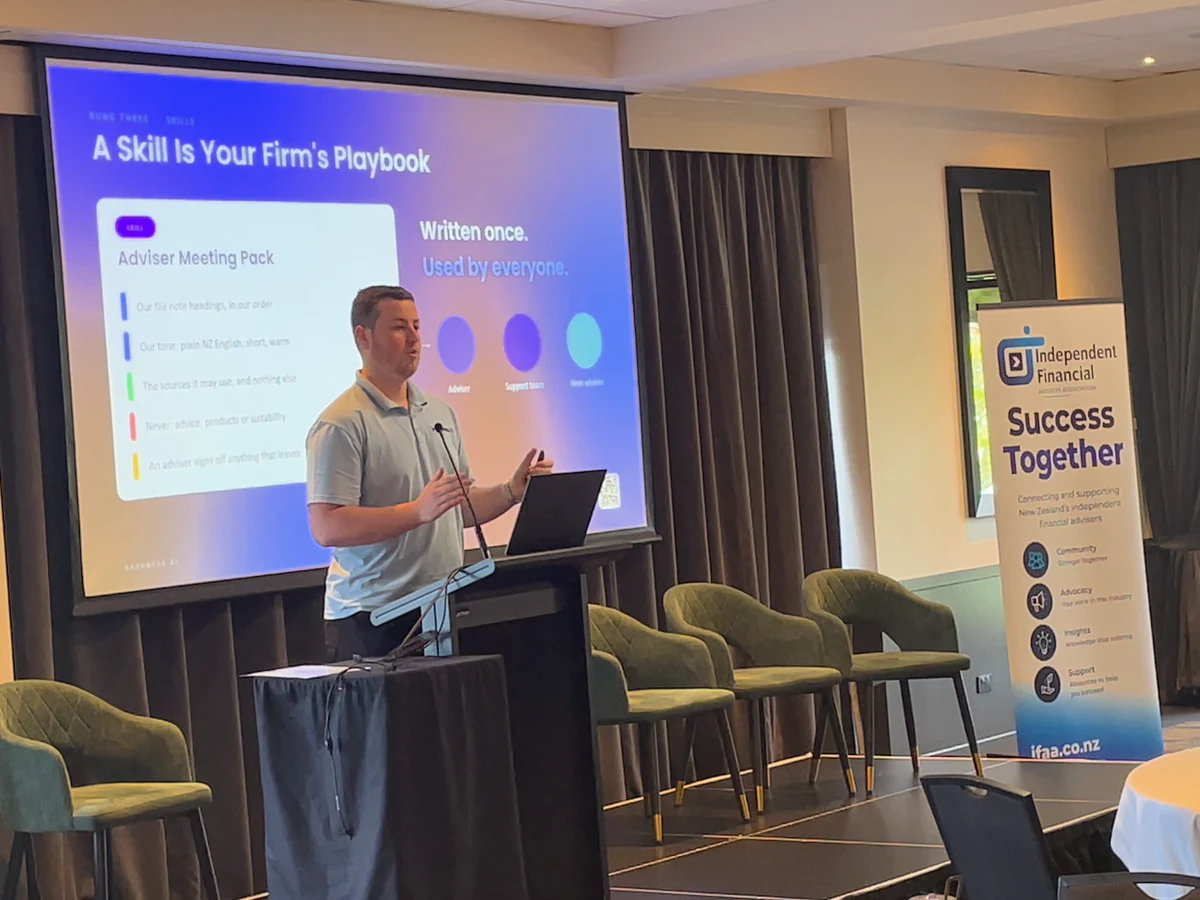
Every manual, repetitive part of my business is a Skill now: proposals, email replies, finding government tenders. Because AI is probabilistic, the same prompt doesn't always give the same answer, and two people in the same role with different instructions get different work. A Skill keeps a firm consistent. The one on screen was an Adviser Meeting Pack:
- Our file note headings, in our order.
- Our tone: plain NZ English, short, warm.
- The sources it may use, and nothing else.
- Never: advice, products or suitability.
- An adviser signs off anything that leaves.
Letting it work
Several of these ran as sped-up recordings that I talked over, all on the same fictional household.
- The application. Some platforms won't let you connect AI to them directly, so Claude in Chrome drives the browser the way a person would. On a mock provider portal it filled a new life and income protection application from what it knew about the client, left the email and smoker status blank rather than guess, and stopped before Submit so a person reviews it.
- Three wordings, one client. Three fictional provider wordings of 20 pages each sat in the client's Drive folder, with the client record in Notion standing in for a CRM. Claude went and found the lot and built one comparison table with page references and what mattered for this client. An adviser asked whether "I read all three wordings" implied the adviser had read them. It didn't: the AI read them and cites where each point comes from, so the adviser's review is faster, not skipped.
- The spreadsheet nobody maintains. Claude inside Excel built a client review tracker, updated it from emails, and checked it for broken formulas, asking before every change it made. With accountants we use the same thing to find the cell someone typed over a formula years ago.
- Your day, briefed by 7am. A scheduled task runs every weekday morning: today's meetings and what each one needs, what came in overnight, and which emails need a reply first.
AI prepares. You approve.
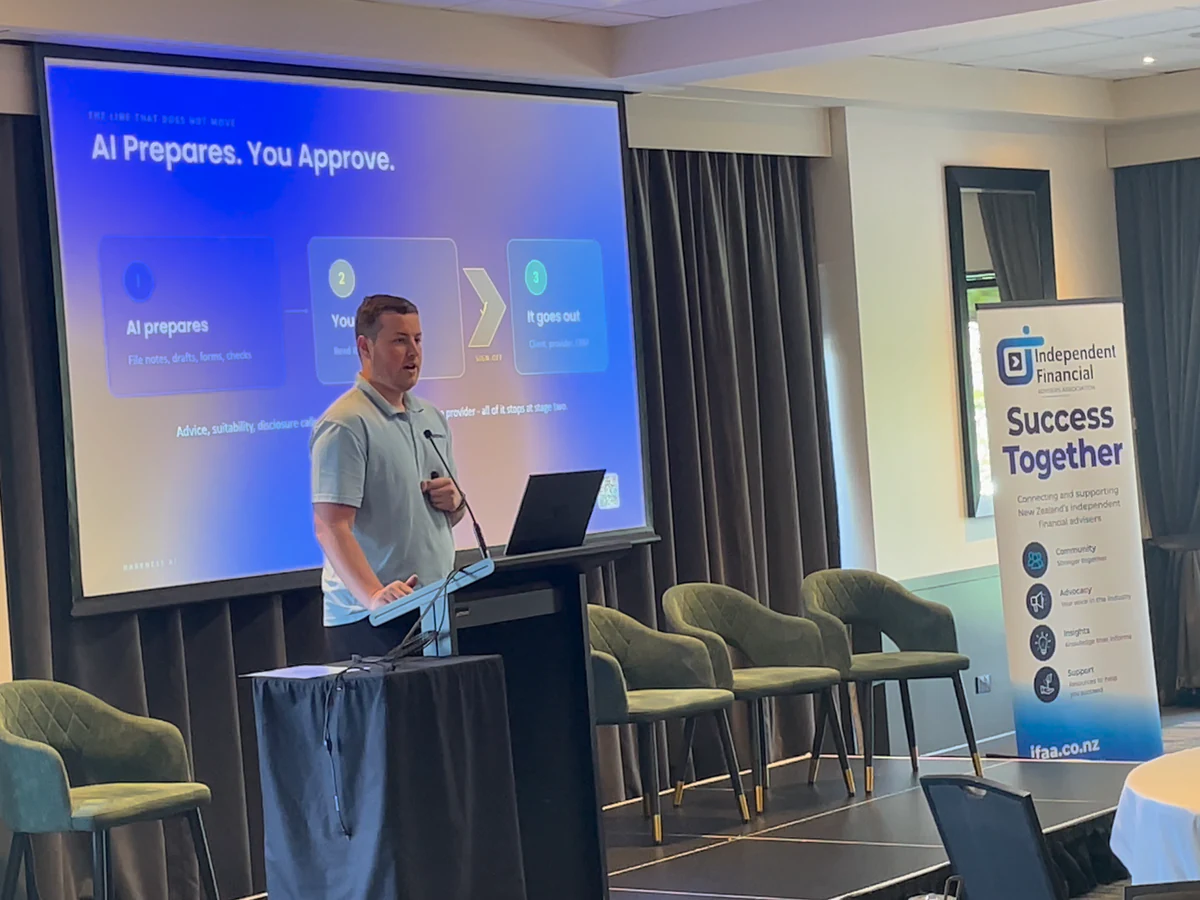
AI gets you most of the way there. Advice, suitability, disclosure calls and anything sent to a client or a provider all stop at the adviser's sign-off. That is where this room is in a strong position: domain expertise is the part a graduate with AI tools doesn't have, because they can get to the end of a task but can't tell whether the output is right.
So the work shifts. Less typing up notes, re-keying the same client into portals, chasing paperwork and reading wordings line by line. More time in front of clients, the harder conversations, advice and judgement. AI is the multiplier, and you are the thing it multiplies. It will draft a legal document for me in thirty seconds, and I have no idea whether it is any good. You would.
The last point was about firms, not tools. AI is a great single player, and the risk is one person quietly doing five times the work while nobody else learns how, the firm can't check it, and it walks out the door with them. Share one win a week, turn what works into a Skill, and learn it together.
Start with the most painful thing
My own process, every week:
- Name it: what was the most painful task last week?
- Get it out: write it down, or just say it out loud.
- Hand it over: tell an AI tool and ask how it could build a Skill for it.
- Test it on real work, not a toy example.
- Rinse and repeat next week, with the next painful thing.
Independent Financial Advisers Association
This is the talk as I gave it, written up from my slides and notes. More talks are in the speaking log. Speaking enquiries go through Harkness AI. Heard me speak? Get the monthly AI Briefing.